
( Liu Jun, Consul-General of the People's Republic of China in Erbil)
Your Excellencies,
Distinguished Representatives of the fraternal parties of the Kurdistan Region,
Esteemed Colleagues and Friends,
It is a profound privilege to be with you today in Erbil to mark the 105th anniversary of the founding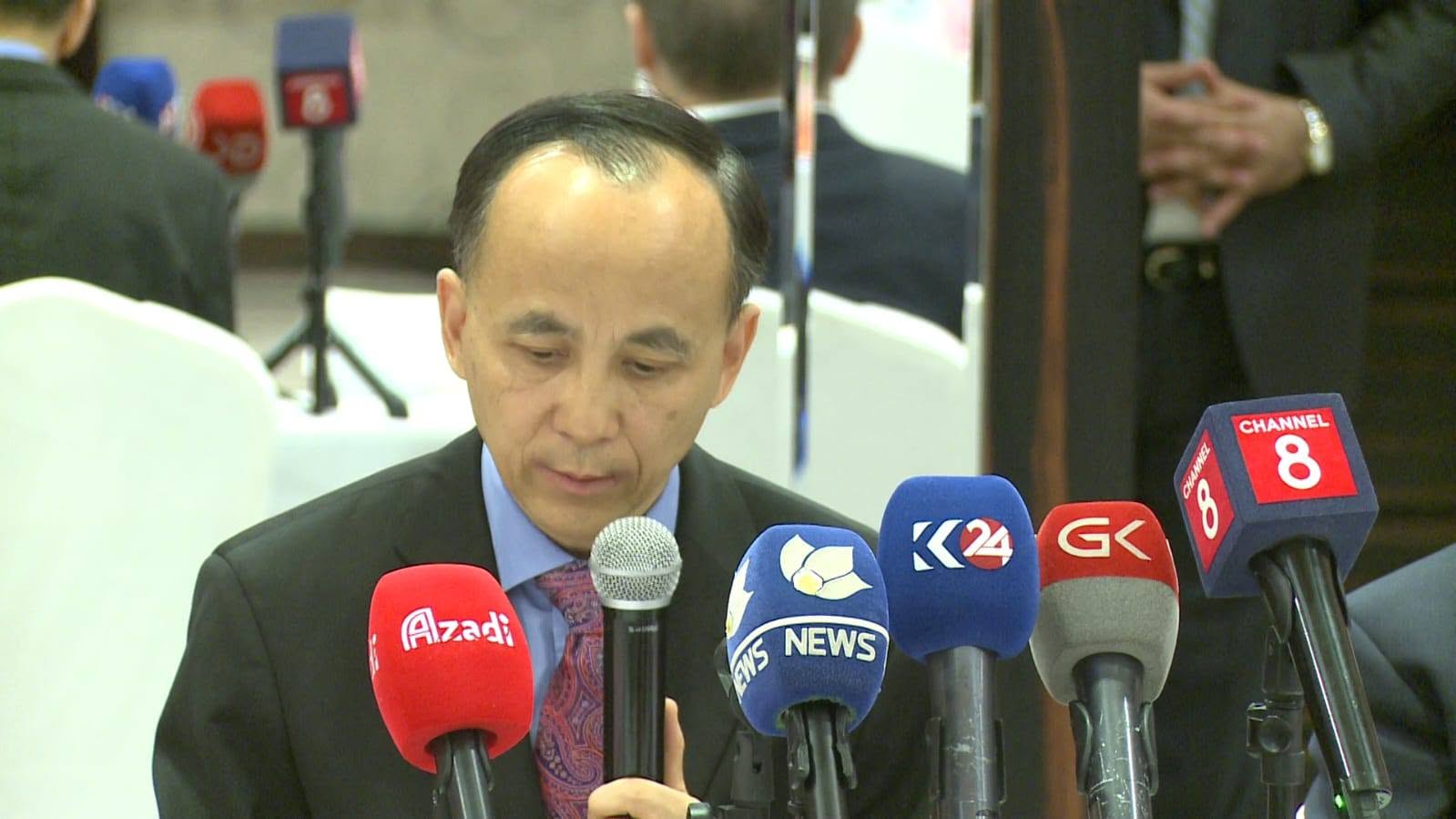 of the Communist Party of China (CPC).
Looking around this room, I see representatives of political parties that have also endured decades of struggle, sacrifice, and state-building. Each of your organizations carries a unique history—forged in the mountains, cities, and hearts of the Kurdish people. Just as you have confronted the steep challenges of liberation, reconstruction, and now peacetime governance, the CPC has traversed a remarkably similar path of trials over the past century.
My purpose today is not to lecture, nor to present a one-size-fits-all model for others to copy. Rather, I wish to share a candid reflection on how we have managed our Party and sustained our governance for past century. In doing so, we look at three fundamental questions that every ruling party must eventually answer:
First, how does a political party grow from a small, underground group into a massive governing structure without losing its core identity?
Second, how does a party with nearly 100 million members and 5.45 million grassroots branches—a scale larger than most nations—keep itself disciplined, transparent, and clean?
Third, how do you maintain the legitimacy to govern when the economy and society are constantly transforming?
Last week in Beijing, General Secretary Xi Jinping, in his address marking our 105th anniversary, decoded six "outstanding traits" of the CPC. These six traits serve as the lens for our discussion today, explaining why the CPC remains resilient:
1. A steadfast pursuit of truth: Always maintaining the correct direction, even when navigating headwinds.
2. Deep roots in the people: Remaining closely bonded to the grassroots, no matter how successful we’ve become.
3. Shouldering our historical mission: Taking proactive strategic initiative rather than merely reacting to events.
4. Moving with the tides of the times: Adapting to global shifts without abandoning who we are and why we are here.
5. Daring to engage in struggle and knowing how to prevail: In Chinese, we call this douzheng. It does not imply warmongering. Instead, it means having the courage to stand firm and the discernment to act effectively when your people’s livelihood, national sovereignty, or core development interests are under pressure—whether at a negotiation table, during a trade dispute, or amid a global pandemic. For any party operating in a complex regional environment—as the Kurdistan Region knows all too well—this trait is vital.
6. Keeping fit through self-revolution: Committing to continuous internal renewal so the Party never decays from within.
I. The 105-Year Journey: Four Distinct Stages, a brief review of the Party’s history. Founded in July 1921 by just 13 delegates, the CPC has evolved into a ruling party of roughly 100 million members. Our history can be understood through four defining stages, each marked by an existential challenge.
1. Survival (1921–1949): In our early days, the Party operated underground, facing brutal suppression. The historic Long March cost us the majority of our forces, but it forged a foundational truth: without the people, there is no power. We learned to embed ourselves deeply within the countryside and among the working class, constantly tailoring political theory to objective reality rather than rigid dogma.
2. State-Building (1949–1978): In 1949, China emerged from the ruins of war. We had to establish national sovereignty and basic industrial systems from scratch. We made mistakes along the way. However, the enduring lesson was clear: running a nation demands systemic planning and professional expertise, not just revolutionary enthusiasm. We realized that a party must master the art of governance, not just the art of rebellion.
3. Reform and Opening-Up (1978–2012): By 1978, we recognized that poverty is not synonymous with socialism. Under the leadership of Deng Xiaoping, we shifted our primary focus to economic development, reforming agriculture, welcoming foreign investment, and eventually joining the WTO in 2001. This pivot lifted over 800 million people out of absolute poverty. We acknowledged that the old planned-economy model had run its course, choosing to reform the system without abandoning our foundational socialist principles.
4. The New Era (2012–Present): Decades of hyper-growth brought new, complex risks: corruption, wealth inequality, and environmental degradation etc. Since 2012, we have institutionalized "Comprehensive and Rigorous Full-Party Governance." At the 105th anniversary, General Secretary Xi underscored our current approach: we are waging "a tough battle, a protracted battle, and an all-out battle" against corruption. We do not allow internal rot to set in; we proactively try to cleanse the organization from within.
II. The Internal Architecture: "Party Building" and "Self-Revolution" Why has the CPC endured? The answer lies in a highly structured maintenance system known as "Party Building". This operational framework is built on a "5+1+1" model: five pillars of construction, plus institution-building, plus the anti-corruption campaign.
The Five Pillars:
1. Political Building: This is our absolute priority. Technical competence is rendered useless if an organization drifts politically. We mandate all members must have a strict alignment with central leadership and national strategy to prevent institutional fragmentation.
2. Ideological Building: We continuously educate our members to adapt Marxist principles to modern realities—such as digital economies and global supply chains—ensuring our intellectual framework remains current and relevant.
3. Organizational Building: Our institutional network extends into every village, university, state-owned enterprise, and private firm. This capillary structure is what allows us to mobilize instantly during crises, whether responding to a pandemic or managing natural disasters.
4. Conduct Building: We wage a constant war against the "Four Undesirable Behaviors"—formalism, bureaucratism, hedonism, and extravagance. Officials who lose touch with the hardships of the ordinary people lose their legitimacy to lead.
5. Disciplinary Building: The Central Commission for Discipline Inspection (CCDI) serves as our internal watchdog. No official is above the law, regardless of their rank or stature.
The First "+1": Institution-Building
This represents our institutional rulebook. Every pillar I have mentioned is codified in written regulations, ensuring the Party operates on institutional systems rather than individual charisma.
The Second "+1": The Anti-Corruption Campaign
This is our primary operational spearhead. If the pillars provide the structure, this campaign provides the continuous enforcement. It is not a temporary fight, but a permanent state of vigilance. The "three battles" stacked together, tough, protracted, and all-out, demonstrate the depth of our commitment.
The Principle of Self-Revolution
History is replete with dynasties and political parties that collapsed because they were incapable of self-correction. The CPC applies a rigorous three-step formula to address corruption:
1. Dare Not: Implementing high-profile, visible punishments to create a powerful deterrent.
2. Cannot: Reforming administrative systems—such as procurement and budgeting—to eliminate the structural opportunity for malfeasance.
3. Will Not: Fostering professional ethics and civic education, ensuring that public service is viewed as its own reward.
Managing a party of 100 million members is not a badge of honor; it is a profound and heavy historical responsibility.
III. Five Planks of Long-Term Governance
Beyond internal discipline, the CPC maintains its governing mandate through five practical foundations that directly impact the daily lives of the population.
1. Poverty Alleviation: Eradicating extreme poverty was treated as a "people's war." We moved beyond generic financial hand-outs. Using big data, we identified every impoverished household across the country, name by name, village by village. We deployed party cadres to live in remote mountain villages for two-year rotations. We extended roads, fiber-optic cables, and solar grids to communities that had never been accessible by transport. This monumental task was achievable only because our 5.45 million grassroots branches reach the absolute bedrock of society. Ultimately, if a party cannot deliver basic food security, infrastructure, and education to its most vulnerable populations, it loses its fundamental mandate to govern.
2. An Industrial Backbone: Many developing economies allow their manufacturing sectors to decline prematurely, pivoting directly to services and relying entirely on imports. China has maintained its manufacturing output above 25% of GDP. We champion a balanced economic ecosystem, supporting both public ownership and a highly dynamic private sector featuring global leaders like Huawei, BYD, and DJI etc. They are the twin engines of our economy. A ruling party requires a resilient, tangible economy beneath its feet, not speculative financial bubbles.
3. People-Centered Governance: GDP growth alone does not guarantee stability; a government must remain structurally accountable. We utilize two core mechanisms. The Mass Line: A practice where officials regularly spend time at the grassroots level to listen to complaints and directly address public grievances. Whole-Process People's Democracy: Ensuring comprehensive institutional consultation before a decision is made, during its implementation, and through subsequent evaluations. Through village councils, labor unions, and digital platforms, citizens actively inform policy. Combined with universal healthcare covering 1.4 billion people, a robust compulsory education system, and the world’s largest pension network, the Party remains fundamentally useful to ordinary families who are managing the costs of healthcare and education.
4. National Security and Resilience: A party cannot govern long if it cannot guarantee the security of the state. Since 2014, we have implemented a holistic approach to national security, encompassing borders, economic stability, food security, energy, cyber defense, and biosecurity. Our rapid, synchronized responses to major challenges, from public health crises to catastrophic earthquakes, demonstrate that institutional resilience is just as vital as economic growth. When disaster strikes, a population expects competence.
5. Strategic Patience Abroad: China’s primary international duty is the stability and prosperity of its own development. We practice neighborhood diplomacy and actively advocate for a community with a shared future for mankind. To date, General Secretary Xi has articulated four interconnected global initiatives: the Global Development Initiative, the Global Security Initiative, the Global Civilization Initiative, and the Global Governance Initiative. History shows that ruling parties that become distracted by external adventures while neglecting their domestic responsibilities set themselves on a path toward failure. We are determined not to repeat that history.
IV. Five Lessons for Long-Term Ruling Parties
From our 105-year journey, we have distilled five essential lessons:
1. Direction Precedes Velocity: A vehicle traveling at high speed in the wrong direction only accelerates disaster. Correct political orientation is infinitely more critical than mere administrative speed.
2. Founding Ideals Require Institutional Renewal: Revering foundational history inspires the initial generations. However, subsequent generations require modern management systems and digital tools. We must translate historical legacies into contemporary relevance while continuously rotating cadres to prevent institutional stagnation.
3. Vigilance Against Institutional Aging: All long-ruling parties face three systemic risks: rigid thinking, leadership complacency, and a disconnect from the grassroots. Regular, unsparing self-examination is the only effective antidote.
4. Dual Oversight is Mandatory: A healthy governance model requires both robust public feedback and rigorous internal audits. Relying solely on external praise breeds complacency, while relying exclusively on internal reporting creates an echo chamber.
5. Longevity Demands Continuous Verification: Historical anniversaries are pit stops, not finish lines. They are moments to inspect the machinery, refuel, and re-verify the map. Long-term governance is a continuous marathon, not a brief sprint.
V. Paths for Mutual Practical Engagement
The CPC does not export its political model. However, we are fully committed to sharing our experiences and fostering mutual learning. To this end, the Chinese Consulate-General proposes four concrete avenues for cooperation within the Kurdistan Region.
1. Youth Cadre Exchanges: We will continue to invite young leaders from the KDP, PUK, KCP, and other fraternal parties in the KRI to visit China for capacity-building programs—focusing on technological innovation in Shenzhen, financial management in Pudong, and our historical governance roots in Yan'an. Equally, we aim to build direct exchanges between the young diplomats at this Consulate-General and the rising cadres of your parties. The future of our bilateral relations rests upon these young leaders.
2. Robust Mutual Visits: Party-to-party exchanges between the CPC and our partners in the KRI have remained active and robust. We want to sustain this momentum, sharing candidly how we manage our vast membership, grassroots branches and anti-corruption campaign etc.
3. Localization of Industrial Partnerships: Chinese enterprises operating locally, such as Huawei, SINOMA, Power China etc, are actively expanding vocational training through ICT initiatives and partnerships with local academic institutions. Working alongside the major political parties here, we hope to scale these efforts to train more local engineers and managers, ensuring that technical expertise is permanently rooted within the Kurdistan Region.
4. Optimizing Cultural and Diplomatic Spaces: Avenues such as the China Study Center at Sulaymaniyah University, the Global Civilization Initiative Research Center, and the Chinese Friendship Park in Erbil represent valuable, neutral ground for intellectual dialogue, research, and youth exchange. Let us work together to fully activate their potential.
Your Excellencies, Dear Friends,
If there is one central message I hope to leave with you today, it is this: a political party’s greatest threat is rarely external pressure, it is internal decay. The six outstanding traits General Secreatry Xi Jinping outlined a few days ago represent our comprehensive strategy against that very danger. If elements of our narrative can serve as a helpful reference as you navigate your own complex futures, then our dialogue today has achieved its purpose.
The Chinese Consulate-General stands ready to facilitate these youth exchanges, mutual visits, training programs, and strategic dialogues. Let us work together to transform today's ideas into tomorrow's shared successes.
Thank you for your time, and I look forward to hearing your insights.